When Music Began to Travel as a Printed Score
Printed music circulation carried written compositions beyond their first performers, while each community still had to turn the page into living sound.
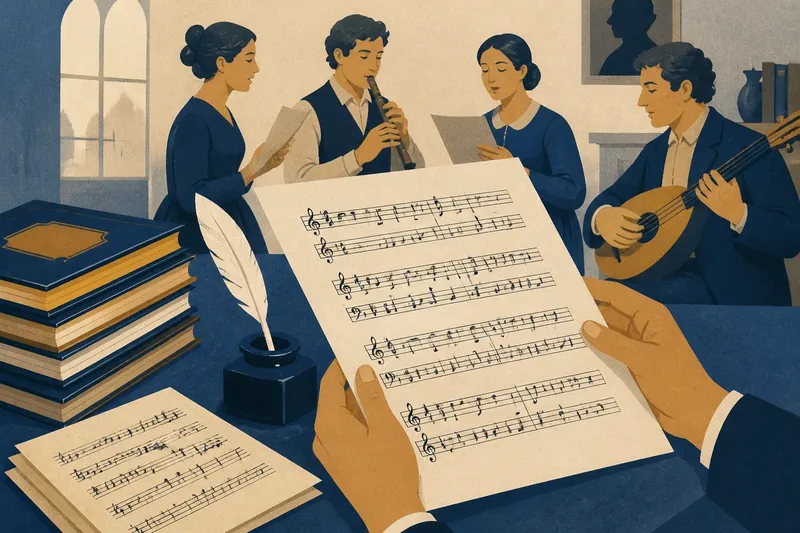
The common mistake is to imagine that a printed score carried a piece of music intact from one place to another. Printed music circulation moved notation, not sound: readers still had to interpret the page, find instruments and singers, and shape a performance for their own room. That distinction explains both the reach of print and the differences that remained between performances.
What changed when music could be printed?
Before music printing became established, a written composition generally travelled as a manuscript, by memory, or through people who could teach and perform it. Copyists could reproduce notation by hand, but each new copy required time and could introduce changes. Printing made it possible to produce multiple copies from a prepared source, giving music a new route to readers who were not present at its first performance.
That did not make every kind of music equally easy to print or circulate. A song with a straightforward melody could fit on a page more readily than a complex composition requiring several staves, carefully aligned parts and specialist notation. Music books, loose sheets and printed parts served different purposes: some invited private singing or playing, while others helped performers rehearse together.
Print also made the written version more visible. A reader could compare a passage with another copy, return to a difficult line, or carry a piece to a different household. Yet a page was not a recording. It could indicate pitches, rhythms, words and musical relationships, but it could not supply the actual timbre of a voice, the flexibility of a phrase, or the acoustics of a particular space.
How did printed music circulation reach new readers?
Printers, booksellers and music sellers formed part of the journey. A composition could be prepared for printing, advertised or offered for sale, then pass through shops, personal collections, teaching rooms and social gatherings. The circulation of a copy depended on ordinary practicalities: who could afford or access it, who could read its notation, and whether the music suited the people who encountered it.
Music could also travel through institutions and networks. A teacher might use a printed piece with pupils; a household might acquire a songbook; a performer might bring printed parts to a gathering. In each case, the page entered an existing musical setting rather than replacing it. Readers made choices about which works to learn, which passages to adapt and which pieces to share.
Printing did not erase manuscript culture. Handwritten copies remained useful when a work was unpublished, when a performer needed a particular part, or when a local version differed from the printed one. Nor did a printed edition necessarily reach every musician. Literacy, access to instruments, local repertoire and the availability of copies all shaped who could use it.
Did a printed score preserve the sound of the first performance?
No. A score preserves selected musical instructions, not a complete acoustic event. Notation can guide a performer towards pitches, durations, entries and relationships between parts, but performers also make decisions about articulation, tempo, balance, ornament and expression. Some of those choices may be suggested by the notation; others depend on convention, training and the character of the occasion.
Imagine a music teacher in a small town receives a printed song for a gathering. The page gives the melody and words, but the teacher has only a local group of singers and a modest accompaniment available. They choose a comfortable key, agree how to begin and shape the ending together; the observable result is a performance that follows the written tune while reflecting the people and resources in the room. The score has travelled, but the sound has been made anew.
This is why a printed edition should not be mistaken for a transparent window onto an original performance. It records a particular written account of a piece. Even when the notation is detailed, it cannot tell a later performer everything that happened in the first room: the exact vocal colour, the interaction among players, or the response of listeners.
Why could two performances from one score sound different?
Because notation leaves room for interpretation, and because performance conditions vary. Two ensembles may read the same marks but phrase a melody differently, use different instruments, or make distinct choices about tempo and dynamics. A composer’s indications can narrow the possibilities without removing them.
The people performing matter, too. A singer’s range may affect the chosen key; an instrument’s design may influence articulation; a group’s habits may shape how it treats a written rhythm. The room and occasion also change the result. Music for a private lesson may be delivered differently from the same piece in a public hall or at a communal celebration.
These differences are not necessarily evidence that one group has misunderstood the score. They can show how written music works as a meeting point between a fixed set of marks and living musical practice. When comparing versions, listen for what the notation seems to hold steady and what performers make their own.
What did printing change about musical tradition?
Printing gave written music a more durable and repeatable form, which could help compositions circulate beyond the people who first heard or performed them. Readers could learn from a copy, return to it later and pass it on. This made the page a participant in musical tradition, alongside memory, teaching and live performance.
But tradition did not become a one-way delivery from printer to audience. Performers still interpreted what they read, and communities could adapt music to local instruments, voices and habits. A printed melody might prompt new arrangements or be remembered imperfectly after the book was put away. The written copy could support continuity while the sound continued to change.
Print also encouraged a useful distinction between a composition as notation and a composition as an event. A score can outlast a particular performance, but its musical life depends on someone choosing to read, rehearse and sound it. A book on a shelf carries potential; a gathering of musicians turns that potential into something heard.
Which questions help explain a score’s journey?
Was music printed before printing became common?
Written music existed long before printed editions, and manuscript copying remained important after music printing developed. Print added another way to reproduce and distribute notation rather than replacing every older route.
Could anyone read a printed score?
Not automatically. Readers needed familiarity with the notation, and some music demanded skills or instruments that were not available to everyone. A printed copy could extend access for those prepared to use it without making musical literacy universal.
Did a printed score include every part musicians needed?
That depended on the edition and its purpose. A publication might present a complete score, a song with accompaniment, or separate parts for performers; readers had to understand what the printed pages supplied before rehearsing.
Can a score tell us exactly how an old piece sounded?
It can offer valuable clues about the written music, but it cannot reproduce a past performance in full. The notation must be read alongside knowledge of performance practice and the limits of what the page records.
How can a listener follow printed music without confusing it with sound?
Start by treating the score as a map rather than a recording. Notice which parts enter, how a melody moves, and where the notation marks a change. Then listen to a performance and ask which features seem guided by the page and which reflect the performers’ choices.
If you have access to a library, a music book or a digital score displayed beside a recording, compare a short passage rather than trying to follow every note at once. Look for a clear entry, a repeated phrase or a written pause. This keeps attention on the score’s practical role: it helps organise musical ideas, while the performers supply the sound.
Printed music circulation changed how written compositions could reach people, but it never made a score self-sounding. The useful distinction is simple: pages travel as objects and instructions; performances happen through particular voices, instruments and decisions. Keeping both in view makes the history of a travelling score easier to hear.