A Listening Walk with One Sound in Mind
A listening walk with one sound in mind turns an ordinary outdoor stroll into focused musical attention, without needing instruments or a recording.
The common mistake on a listening walk is trying to notice everything at once. The result is a jumble of traffic, birds and footsteps, and the small changes that make a sound interesting slip past. A listening walk with one sound in mind gives your attention a gentle anchor: choose one non-musical sound, follow it as it changes, and notice the musical qualities it suggests.
What does one sound give you to listen for?
Pick a sound that is already part of the place: rain tapping a shelter, a gate creaking, leaves stirring, or a distant vehicle passing. You are not trying to turn it into music or decide whether it is beautiful. The aim is to stay with its audible details instead of letting your attention jump to each new noise.
A single sound can change in several ways. It may grow louder as it approaches, break into irregular pulses, become muffled behind a wall, or disappear beneath another sound. Following those shifts makes the walk less like collecting noises and more like listening to a performance whose parts keep changing.
How do you choose a sound you can follow?
Choose something that is likely to remain audible for part of your walk, but does not demand your full attention for safety. A fountain, wind in one stand of trees, or the rhythm of footsteps on a public path can work. If the sound vanishes quickly, let it go and choose another rather than chasing it into an unsuitable place.
Before setting off, pick a familiar public route with room to pause. Keep your eyes open, leave headphones off, and do not cross roads or approach machinery to hear more clearly. The sound is a focus for listening, not a reason to ignore where you are.
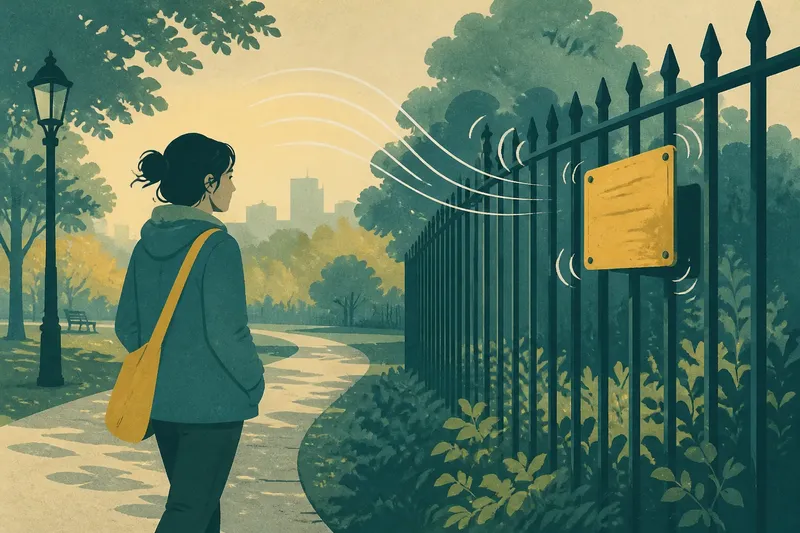
Say you begin beside a park fence and choose the rattle of a loose sign in the breeze. As you walk along the path, you hear separate clicks, then a quicker cluster when the gust strengthens; farther away, the rattle softens into a thin, uneven shimmer. You have followed one sound through changes in pace, weight and distance without needing to label it as a tune.
Which musical qualities can an ordinary sound suggest?
Notice what the sound does before reaching for musical vocabulary. A steady pulse may suggest a beat; an irregular sequence can feel hesitant or playful. A low rumble beside a sharp tick creates contrast, while a sound that swells and fades has a contour, rather like a phrase that gathers and releases energy.
- Pulse: Does the sound repeat evenly, or does its timing keep shifting?
- Timbre: Is it hollow, rough, bright, soft, metallic or airy?
- Pitch: Does it seem to rise, fall or hover in one register?
- Dynamics: Does it become stronger, quieter or more distant?
- Texture: Is it a single clear event, or layered with other sounds?
These are listening prompts, not tests with right answers. “Bright” might describe the crisp edge of a bicycle bell, while “rough” might fit wind moving through dry leaves. Your words help you attend to a quality; they do not need to match anyone else’s.
How does the sound change as you move?
Movement changes what reaches your ears. A building can block high, delicate details while a lower hum carries around it. On an open stretch, a sound may seem broader; near a wall, reflections can make it feel closer or less distinct. Notice the effect without assuming that the sound source itself has changed.
Give silence a place in the walk, too. When your chosen sound pauses, notice what remains: a distant engine, birds answering one another, or the soft noise of your own clothing. If the original sound returns, compare its texture or apparent distance with what you heard before. The gap is part of its shape in your attention.
You can also notice how nearby sounds alter the impression of your chosen one. Footsteps may create a temporary beat beneath a fountain’s continuous hiss. A gust might cover a bird call, then leave it exposed again. Treat these as passing relationships, rather than trying to arrange the surroundings into a finished composition.
What questions help you listen more closely?
Should I record the sound?
You can, but a recording is optional and will not preserve the full experience of moving through a place. If you use a phone, stop somewhere safe and make a brief note of what changed before reaching for it.
What if the sound disappears?
Let it disappear and notice what its absence makes audible. You can continue with the same sound if it returns, or choose another sound at your next pause.
How long should I follow one sound?
Stay with it for as long as your attention remains curious and the route is comfortable. A short stretch can reveal a useful change; there is no need to complete a particular distance or duration.
Does the sound need to resemble music?
No. The exercise is about noticing qualities such as pulse, contrast and contour, not claiming that every outdoor noise is a piece of music. A sound can suggest musical ideas while remaining exactly what it is.
How can you carry the listening beyond the walk?
Afterwards, jot down a few plain observations: what you followed, how it changed, and one quality that surprised you. “The sign began with spaced clicks, then rattled quickly” is more useful than a vague note such as “nice sound”. A voice memo can help if writing outdoors feels awkward, but keep it short enough that you remember the listening rather than the device.
On a later walk, choose a different kind of sound rather than trying to improve on the first one. A continuous sound, such as water, invites attention to texture; a recurring sound, such as a gate, makes timing easier to hear. This keeps a listening walk with one sound in mind open-ended: the same street can offer a different set of musical qualities whenever weather, movement and attention shift.
Choose a route where you can pause without blocking others, and let the sound set the pace of your attention rather than your feet. That small adjustment is often enough to make an ordinary walk feel newly detailed.