Keys, Valves, and the Different Routes to a New Note
Compare how keyboard and valve instruments change pitch, and learn what their physical controls reveal about fingering, airflow and musical choice.
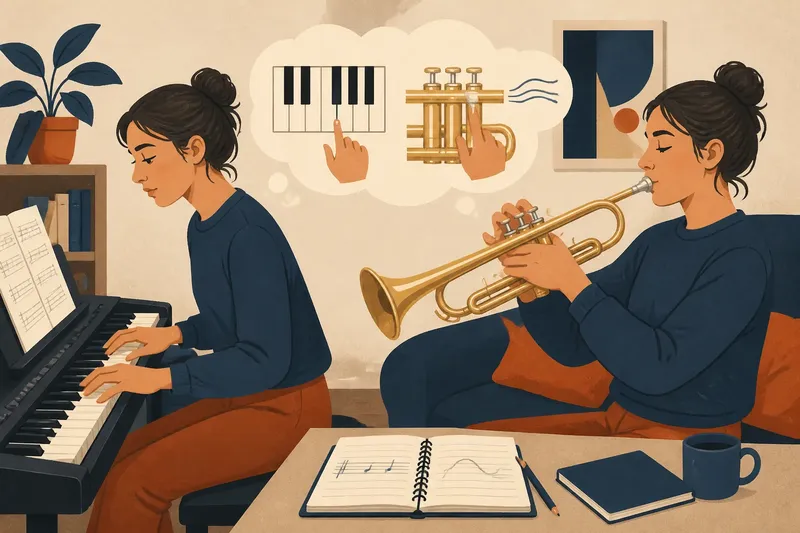
The most common mistake when comparing a piano with a trumpet is to call both sets of controls “ways of pressing notes”. That shortcut hides what the player actually does: a pianist selects a prepared pitch with a key, while a trumpet player combines valves with breath and lip shape to steer a resonating column of air. Hearing that difference makes the instruments easier to understand, and helps a new player choose which physical challenge feels inviting.
What does a key actually change?
On a piano, each key is connected to a mechanism that sets a hammer in motion. The hammer strikes a group of strings, and the player’s finger chooses which pitch will sound. Pressing a key does not shorten a string by hand or reshape it; the instrument’s tuning and mechanism have already arranged the available pitches.
That makes the keyboard a visible map. Notes rise from left to right, and the repeating pattern of white and black keys gives a player a stable way to locate them. The same basic layout appears on an electronic keyboard, though the sound-producing mechanism may be electronic rather than a hammer striking strings.
A key is not merely an on-off switch, however. On an acoustic piano, the speed and weight of the keystroke affect the hammer’s action and therefore the character of the sound. Sustain pedals and the release of a key also shape what happens after the initial strike. The pitch choice is discrete, but timing, touch and resonance remain expressive.
For a beginner, this division can be reassuring: choose a key to choose a pitch, then attend to rhythm, touch and listening. It can also feel demanding, because several notes may be played at once and the hands must find their places across a broad layout. A keyboard makes pitch locations easy to see, but does not automatically make coordinating them easy.
How do valves lead to a different pitch?
A trumpet’s valves redirect air through additional lengths of tubing. Pressing a valve changes the instrument’s effective tube length, lowering the pitch available from a given way of vibrating the lips. The player does not simply press one valve for every note: different valve combinations provide different routes to notes, while breath and embouchure—the way the lips meet the mouthpiece—help select and centre the sounding pitch.
That combination is why a brass player’s fingers alone do not tell the whole story. The same valve combination can serve more than one note in the instrument’s range. The player changes the air and lip vibration to move between those possibilities. The instrument offers a set of pathways; the player’s body helps determine which path is sounding.
Valve action has a tactile quality that a keyboard does not share. The fingers operate a compact set of buttons, often without a one-button-per-pitch map. A player learns combinations and connects them to the notes heard and felt. On a trumpet, the right hand normally works the valves while the left supports the instrument; other valved brass instruments may arrange the controls differently.
Pitch is also more continuously adjustable on a brass instrument than it is on a standard piano keyboard. A player can shade a note with the lips and air, and can make small corrections while sounding it. That flexibility is useful for expressive phrasing and tuning with other musicians, but it asks for careful listening and control. It is not the same as pressing a key and receiving a fixed pitch.
What changes for the player’s hands and body?
The difference becomes clear in a simple musical task: moving from one note to another. A pianist lifts one finger and depresses another key, or moves several fingers together for a chord. The hand travels across a surface whose geography remains visible. The player can look down and see the next destination.
A trumpet player may change valve combination, adjust lip vibration, and manage the breath without shifting the instrument’s position much at all. The fingers make a small movement, but the mouth and air do substantial work. Looking at the valves alone can make the action appear simpler than it is.
These different demands affect how practice feels. Keyboard practice often involves locating notes, coordinating both hands, and shaping the attack and release. Valve-instrument practice also involves learning fingerings, but must include producing a steady tone and hearing whether the intended pitch is centred. Neither instrument is simply “more physical”; each distributes effort differently.
Imagine a fictional beginner, Leila, who wants to play a short tune she can hum. She first tries it on a digital keyboard, where she can match each sung note to a visible key and hear the tune without having to form a tone with her breath. Then she borrows a trumpet and finds that knowing the tune does not tell her which valve combination and lip adjustment will produce each note. Her likely next step is not to abandon one instrument, but to recognise that the keyboard teaches her pitch locations while the trumpet asks her to coordinate fingering, air and listening.
How does each instrument handle notes between the keys?
On a standard piano, the keys divide the available pitches into fixed steps. A player cannot slide a finger smoothly from one key to the next and make every intermediate pitch sound. Some keyboard instruments can bend pitch electronically or through other controls, but that is a feature of those instruments rather than the ordinary action of a piano key.
A trumpet can move between pitches with a continuous change in lip vibration and air, producing a slide-like effect or a carefully shaped transition. Players can also use alternate fingerings and other techniques to influence intonation and colour. The result depends on the player’s control and the musical context, not just on which buttons are pressed.
This contrast is audible in the shape of a note. A piano note begins when the hammer strikes and then fades according to the instrument and the way it is played. A trumpet note can be sustained as long as the player manages the airflow, and its pitch and tone may change during that sustain. A keyboard player can shape duration with touch and pedal, but the mechanism of the sound remains different.
Neither approach is a universal advantage. Fixed keys make it straightforward to reproduce a chosen pitch and to play several notes at once. A brass player’s continuous pitch control allows fine inflection within a note, but requires the ear and body to work together. The difference is part of each instrument’s expressive vocabulary.
What should you listen for when comparing them?
Rather than asking which instrument has “more notes”, listen for how each note begins, changes and ends. In a piano phrase, notice the distinct attacks and the way one note can overlap another through resonance. In a trumpet phrase, notice whether the tone swells, settles, bends or changes colour while it continues.
It can help to compare a short, familiar melody played on both instruments. Attend to the pitch transitions rather than the tune’s identity: does the player step cleanly from one pitch to the next, or connect the pitches with a slight bend? Then notice how a sustained note behaves. The comparison is most revealing when the melody is simple enough that the mechanics remain audible.
Also listen to the spaces between notes. A pianist’s fingers can release keys to stop their strings from sounding, while a brass player shapes phrases through breath and tongue articulation. Both can make a note short or detached, but they arrive there through different physical actions. A clean separation on a keyboard and a crisp brass articulation may sound alike in a phrase while feeling quite unlike one another to perform.
Which instrument suits the way you want to learn?
If you are choosing an instrument, consider which task you would enjoy repeating: finding pitches across a visible layout, or coordinating a compact fingering system with breath and embouchure. A keyboard can make it easy to inspect melodies and chords at a glance. A valve instrument may appeal if you want to shape a sustained tone directly with your breath and lips.
Practical circumstances matter too. A digital keyboard can be used with headphones in many home settings, while a trumpet has a sound that carries into the room and needs a suitable place for practice. If you can, try both with a teacher or experienced player present. A short introduction can show whether the keys feel intuitive or whether the first breath and valve combination spark your curiosity.
For a young learner or someone returning to music, avoid judging solely by the first few minutes. A piano’s layout may seem obvious while coordinating two hands takes patience; a trumpet’s controls may seem mysterious while a first clear tone can be deeply satisfying. Ask which difficulty you are more willing to meet regularly, and what kind of sound you want to make.
What questions do players often ask?
Do trumpet valves correspond to the piano’s black and white keys?
Not one-to-one. A piano key selects a particular prepared pitch, while trumpet valves alter the tubing and work with the player’s lips and airflow to produce notes across the instrument’s range.
Can a trumpet play a note without pressing a valve?
Yes. The player can produce notes using the open tubing and different lip vibrations, though the available notes depend on the instrument and the player’s control.
Can a pianist change pitch while a note is sounding?
On a standard piano, the pitch of an individual struck string is not smoothly bent by the player after the attack. A pianist can shape its loudness and resonance, while electronic keyboards may offer separate pitch-bending controls.
Is learning piano fingerings easier than learning valve fingerings?
They pose different challenges rather than a simple ranking. The piano shows pitch locations clearly, while trumpet fingerings must be linked to breath, embouchure and listening for accurate pitch.
Why do these controls matter beyond technique?
The controls shape what a player can notice. At a keyboard, the eye and hand can connect a note’s place on the instrument to its sound. On a trumpet, the player learns to notice airflow, lip response and the changing resonance of the instrument. Each route builds a different kind of musical attention.
That is the useful lesson in comparing keys and valves: a control is not just a shortcut to a note. It determines which parts of sound-making the player can touch directly and which must be prepared by the instrument. Once you hear that distinction, the next time a piano and trumpet share a melody, listen for the different physical decisions behind every change of pitch.